We have a good Korean friend who suggested we visit Andong. It's a small city about three hours southeast of Seoul. To be honest, it wasn't on my bucket list, and I can't believe it wasn't, because it's now my favorite thing I've done here in Korea! Thanks Eunhi for the recommendation. :)
After doing a little research about our trip, I learned that the city became famous after a visit from Queen Elizabeth II. Apparently, when visiting Korea she asked to be taken to the "most Korean" place in all of Korea. She was brought to Andong.
And I can see why.
I felt like I had stepped back in time. Everything there seemed so old fashioned compared to what I see in Seoul everyday. Honestly, it just felt more Korean! It's probably how foreigners feel when they visit Texas in America -- people in cowboy hats and cowboy boots herding cattle at their ranch -- textbook America. That's how Andong was for me. So much of Korea these days looks like a major city in America. Everything is modern and busy. While the food and culture may be a little different, sometimes it's hard to remember I live in a foreign country. Visiting Andong, though, was like taking a trip in a time machine and seeing the Korea that existed 100 years ago. It was absolutely beautiful!
And I can see why.
I felt like I had stepped back in time. Everything there seemed so old fashioned compared to what I see in Seoul everyday. Honestly, it just felt more Korean! It's probably how foreigners feel when they visit Texas in America -- people in cowboy hats and cowboy boots herding cattle at their ranch -- textbook America. That's how Andong was for me. So much of Korea these days looks like a major city in America. Everything is modern and busy. While the food and culture may be a little different, sometimes it's hard to remember I live in a foreign country. Visiting Andong, though, was like taking a trip in a time machine and seeing the Korea that existed 100 years ago. It was absolutely beautiful!
Our first stop was the Dosan Seowon.


This was a Confucian Academy built in the 1500s by Yi Hwang, a very famous Confucian scholar. He is actually the man on the 1000 won bill (equivalent to the dollar bill),
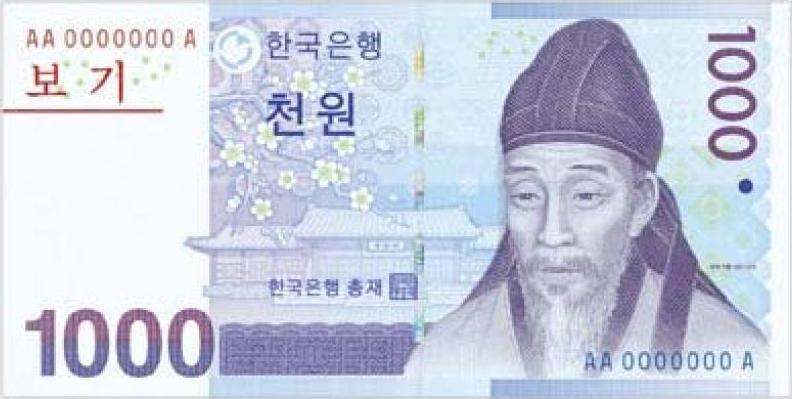
and on the back side is the Dosan Seowon.

I've looked at this bill thousands of times and never really thought about what this picture was. It was pretty cool to think we were standing on that very spot. In fact this tree was actually growing during the time of Yi Hwang. Pretty cool!

The academy served two purposes: education and commemoration. Yi Hwang originally created a Confucian Academy here for students to study in the ways of Confucianism and improve their lives. After his death, a shrine was also added. We could take a picture at the door to the shrine, but couldn't enter.

I loved every second of being here as you can tell by the copious pictures I took! If you were wondering what the Dosan Seowon looked like, you're in luck, because I took enough pictures for you to feel like you've been there. Enjoy!


We decided that since this was a Confucian Academy, we needed to do a little scholarly work. We each took turns meditating and writing a poem.


I definitely liked Pete's the best...

It reads:
Writing poetry
I hate it
I'm glad I didn't
go to the
Dosan Seowon.
I love my husband! He makes me laugh.
Emma decided she didn't want to write her poem outside around any bugs. So she wrote hers inside the air conditioned museum instead. Just as fun and inspiring!

It was in such a peaceful location.

We hated to leave.

But we also couldn't wait to try Andong's jjimdak which was our next stop.
This is jjimdak alley.

Inside the covered alley way in front of us is restaurant after restaurant specializing in jjimdak. These "alleys" are definitely something that took me a little while to get used to in Korea. In America, if you want to open a steak restaurant, you look for an area where there aren't any other steak restaurants because you don't want to compete with anyone else. Competition drives down prices, and that's not what you want as a business owner. In Korea, though, it's the exact opposite. No one would even think of opening a steak restaurant away from "steak alley" because that's not where the consumer would think of looking for steak. Plus, all the local farmers bring their fresh produce and meats to these "alleys" as they are called, and sell the freshest ingredients directly to these restaurants at the cheapest prices. So Korea really does have a consumer's market. Low prices with the highest quality foods all in one area. While this idea seemed bizarre at first, it's definitely grown on me!
This is the restaurant we chose.


And here is Andong Jjimdak.

It's kind of like a chicken stew: chicken, potatoes, carrots, and noodles all cooked in a sweet and spicy sauce. Delicious!!! One of my favorite Korean foods. We ate ourselves sick. Even Emma liked it! Although, she did have rice to go with it. ;)

After rolling ourselves out of the restaurant, we headed over to a hanji paper making factory.
Hanji is Korea's traditional paper. Made from mulberry trees, it was used for everything from doors, to windows, to books and paper.
These are the mulberry trees.

And here is the bark ready to be cooked down.

After cooking many times and removing the impurities, you have this beautiful pulp remaining to make paper from. The kids each got a turn to make their own hanji.


Here's Emma pressing hers between these giant cloths to get all the water out.

Then they brushed it to flatten it and make nice lines in the paper.

And here is the final product. You can see all the different types of hanji in the background. It's really beautiful. When finished, it feels like a mixture between paper and cloth. It's very soft.

There was a fun little playground outside the factory, so we took a few minutes to play on it.

The Korean exercise equipment is always fun!

Finally it was time to head to the Hahoe Village where we would be spending the night in a traditional Korean house. We couldn't drive our car in until after 6pm when the village closes down to tourists for the evening. It was pretty cool driving our car into this neighborhood.

Although I have to admit, I don't think they were expecting minivans to drive on these streets when they planned them. It was a rather tight squeeze.


It was delicious!
And here was our little hanok. We had the whole thing to ourselves!

It had three bedrooms, a bathroom, a kitchen, and a living space.
Here are Emma and Ryan in their bedroom.

Peter in ours.

Ali in hers.

The kitchen is in off to the right.

And here is the living space, complete with a table.

By the time we ate dinner and settled into the place, it had started to rain. So we broke out the games and spent the evening playing Settlers of Catan in our traditional Korean house.

I actually slept really well for sleeping on the floor. The last time we tried this, it was way too hot. This time, it was absolutely perfect! There was a wonderful breeze blowing that cooled down the entire house. It was so quiet too. After spending the last year and a half in a bustling city, it was nice to fall asleep without hearing cars and yelling people.
This was the view from our house.


It truly was a nice break from the city.
In the morning, Ryu Se-ho gave us a tour of his house.

It is the original house built 210 years ago and has been designated as a national treasure. When famous people come to visit Andong, they stay in this house. He had a wall of photos of dignitaries who have stayed in his house. I asked if he was going to add our picture to his wall. After he realized I was joking, he laughed.


This tree growing on his property has also been designated as a nation treasure. The curve in the tree exactly mirrors the river that surrounds this village and gives it its name.


Here is Mr. Ryu with our children. He was such a nice man. I highly recommend staying here if you visit Andong. It's rather pricey, but worth the cultural experience.

After the tour, we spent the rest of the morning walking around the village. Because we spent the night here, we had access to the village before tourists came. It was nice to have the whole thing to ourselves. (Except for the locals who live here of course.) While the Hahoe village is a tourist destination, it's simply a village where people farm and live. It gives you a look back into what Korea was like when fishing and farming were still the major industry.


The kids' favorite place in the village was the traditional play yard.
Giant swings


Ring toss


Wrestling


But our absolute favorite was the standing seesaw. I'm sure it has a more Korean name, but that's what we called it. Ryan had learned about these in Korean culture class. Apparently in the old days the girls used to use them to try to see over the fences since they weren't allowed to leave the yard.
They were so much fun!

Check out how much air Ryan got!!!

Here's Ali

Even Emma enjoyed getting a little air too.


It was fun to visit in the spring because we were able to see everything being planted.

My favorite was the rice. I've never actually seen how it's planted.
Here you can see this field that already has the rice in it.

The field on the right is completely flooded, waiting to be planted.

While the rice was all planted by hand years ago, this is the machine they use now to fill these fields with rice.

It was so much fun to watch.

These are the trays of rice waiting to be planted. You can see just the tops sticking out of the water after it's planted. Notice the planted rice in the background.


Our final stop was to get a bird's eye view of Hahoe Village from the top of this cliff.

Apparently the cliff looks a lot taller than it is, because it only took us a few short minutes to reach the top. Well worth the climb. The view was beautiful!


Again, I can't believe I didn't have Andong on my list of things to do in Korea. Having been here now, I can't imagine coming to Korea and not experiencing Andong. It truly is the "Capital of the Korean Spirit" as its motto claims.
I have to admit, I felt a little more Korean for being here. ;)
